
Flooring
Bespoke Stair Runners for Period and Contemporary Homes
A bespoke stair runner is a carpet made to precise stair and landing dimensions, usually leaving an exposed border of timber either side and finished with whipped edges or bound tape. It suits straight, winding and open-plan staircases alike, and can incorporate borders, stripes or pattern to complement an existing hall carpet or stand as a striking feature in its own right.
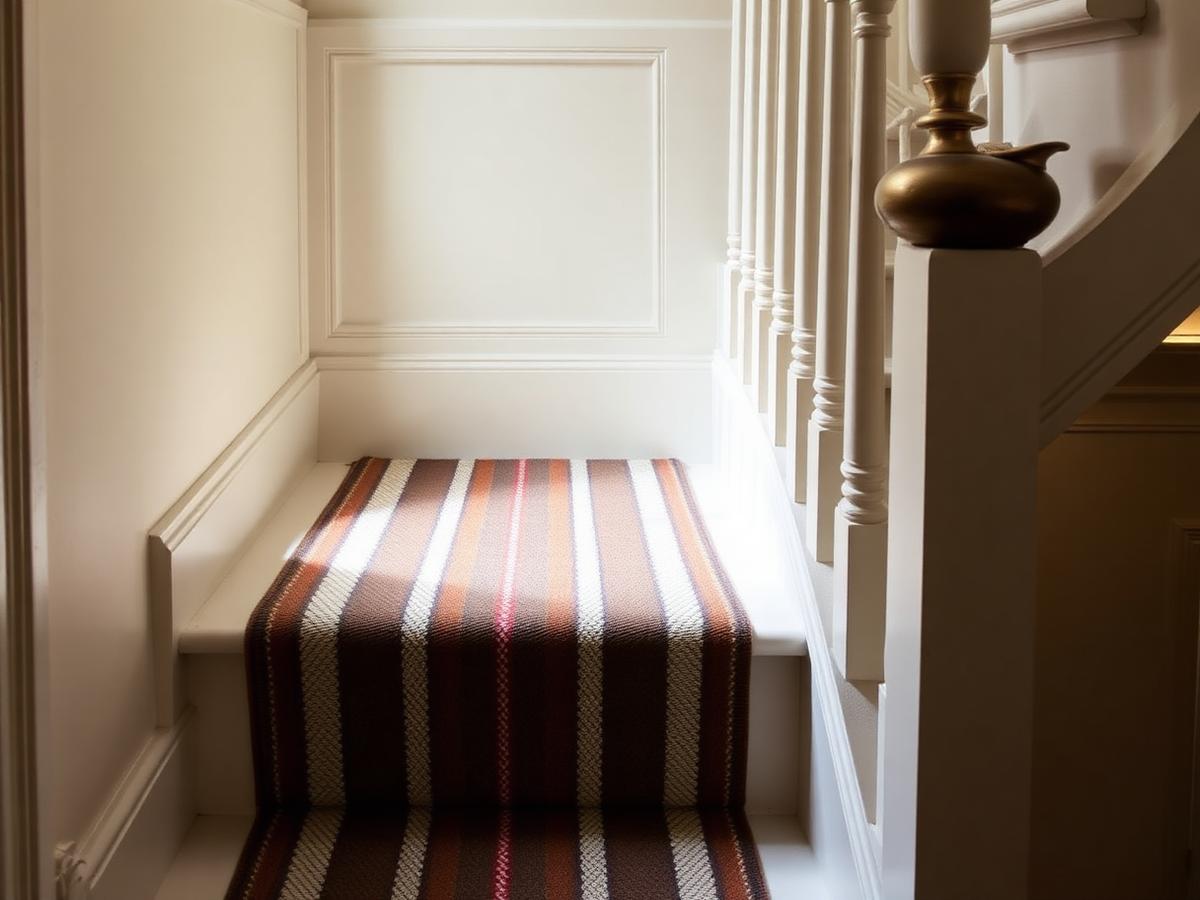
The staircase is often the first thing seen on entering a home, and a bespoke runner brings proportion, warmth and character to it in a way fitted wall-to-wall carpet rarely achieves. As our flagship service, we template every stair and landing individually, advise on width, border and edge finish, and manage installation on straight flights, winders and open-plan staircases with equal precision.
Templated to your staircase
Every tread, winder and landing measured individually, not assumed from a standard width.
Pattern, stripe and border expertise
Advice on proportion, direction and colour so the finished runner reads correctly.
Whipped edges or bound tape
Finished by hand for a crisp, durable edge that resists fraying.
Stair rods and hardware
Guidance on rod styles and fixings where a traditional finish is wanted.
Why a bespoke runner over fitted stair carpet
A runner leaves a border of exposed timber tread either side, which lets the staircase's joinery remain visible and adds a sense of proportion and architectural intent that full-width fitted carpet cannot offer. It also allows a bolder pattern, stripe or colour to be used with confidence, since the border of wood frames and calms the design.
Runners are particularly suited to period properties, where original staircases and balustrading deserve to be seen, but they work equally well on contemporary staircases where a runner introduces warmth and definition against pale joinery or glass balustrades.
Pattern, stripe and colour choices
Striped runners are a classic choice and read cleanly on a straight flight, though stripe width and direction need care on winding stairs so the pattern does not distort awkwardly around the turn.
Patterned Wilton-woven runners, whether florals, geometrics or classic border designs, add richness and are particularly effective on grander or more formal staircases, while a plain or subtly textured runner suits a quieter, more contemporary scheme.
We help match, or deliberately contrast, the runner with an adjoining hall or landing carpet so the transition from floor to stair feels considered rather than incidental.
Borders, whipped edges and stair rods
A contrasting border tape along the runner's edge sharpens its outline and is a traditional detail that suits period interiors especially well. Edges are typically finished either with whipped stitching, a hand-worked overcast stitch in matching or contrasting yarn, or with a bound tape edge for a crisper, more tailored line.
Stair rods, in brass, chrome or a painted finish, hold the runner at the base of each riser and add a traditional, tailored finish. They are optional rather than essential, and we advise on whether they suit the staircase's character before specifying.
- Whipped edge: hand-finished, traditional, subtle texture
- Bound tape edge: crisp, tailored line, wide colour choice
- Contrast border: defines the runner's outline
- Stair rods: traditional detail, brass, chrome or painted
Winding stairs, open-plan staircases and landings
Winding or curved staircases require the runner to be cut and turned carefully at each winder tread so the pattern or stripe continues logically around the bend rather than kinking or narrowing awkwardly; this is where templating and fitting experience matter most.
Open-plan and floating staircases, increasingly common in newer builds, often have exposed tread ends and no traditional stringer, which changes how the runner is finished and secured; we assess each staircase individually rather than applying a standard approach.
Landings are treated as an extension of the stair design, with the runner either continuing as a matching border-edged carpet or transitioning into a fitted landing carpet, depending on the layout and how the space is used.
Matching a hall carpet
Where a runner leads from a hallway, we consider whether the hall carpet should match the runner exactly, echo its border or colour, or contrast deliberately. A consistent approach across hall, stairs and landing generally reads as more considered, particularly in open sightlines from a front door.
Installation and technical considerations
Templating is carried out on site, treated individually, to account for any variation in tread depth, riser height or wall alignment that a standard-width runner would not accommodate.
Underlay beneath a runner should be firm enough to resist excessive compression on tread nosings, which see the greatest concentrated wear, while still cushioning the stair adequately.
Fitting on stairs demands precise gripper placement and tensioning at each tread and riser to keep the runner secure, straight and safe underfoot, particularly at winders where geometry is less forgiving.
Caring for your stair runners
- Vacuum stair treads regularly, paying particular attention to nosings where wear concentrates.
- Blot spills immediately rather than allowing them to soak into the pile on tread edges.
- Check stair rods periodically for secure fixing if fitted.
- Have runners professionally cleaned on the same cycle as adjoining carpets for a consistent appearance.
- Inspect whipped or bound edges occasionally for any early signs of wear and address promptly.
Frequently asked questions
- What is a stair runner and how is it different from fitted stair carpet?
- A stair runner is a carpet made to a set width that leaves an exposed border of timber tread either side, whereas fitted stair carpet covers the full width of each tread. Runners suit both period and contemporary staircases and allow bolder pattern or colour choices framed neatly by the visible wood.
- Can a runner be fitted to a winding or curved staircase?
- Yes. Winding staircases require the runner to be cut and turned carefully at each winder tread so the pattern continues logically around the curve. This needs accurate on-site templating and experienced fitting, which is a core part of how we approach every staircase.
- Should the stair runner match the hall carpet?
- It often works well to match or closely echo the hall carpet so the transition feels considered, particularly where sightlines run from the front door to the stairs. A deliberate contrast can also work, but this is a design decision we discuss in relation to the wider scheme.
- What edge finish should I choose for a stair runner?
- Whipped edges, a hand-worked overcast stitch, give a traditional, textured finish, while bound tape edges give a crisper, more tailored line and a wider choice of contrast colours. Both are durable when properly finished; the choice is largely one of character.
- Do I need stair rods?
- Stair rods are a traditional decorative detail rather than a structural necessity, holding the runner neatly at the base of each riser. They suit period staircases particularly well and are available in brass, chrome or painted finishes, but a runner works perfectly well without them.
- How wide should a stair runner be?
- Runner width depends on the staircase width and how much exposed timber border is wanted either side, typically leaving a consistent margin of several inches. We measure each staircase individually to recommend a width that is proportionate to its scale and detailing.
- Can a runner be fitted on an open-plan or floating staircase?
- Yes, though open-plan and floating staircases often have exposed tread ends and no traditional stringer, which changes how the runner is finished and secured. We assess the construction of each staircase before recommending an approach.
Last reviewed 2026-08-04.
Other flooring collections
Consultation
Planning a flooring project?
Tell us about your property, ideas and timescale. We will help you explore the most suitable materials and arrange the next step.